
I am not a financial advisor and nothing in this post constitutes financial advice. All investments carry risk and the value of your investments can go down as well as up. Please do your own research and consider seeking independent financial advice before making any investment decisions.
Last reviewed: 8 November 2026. Figures are for the 2026/27 tax year and correct at the time of writing.
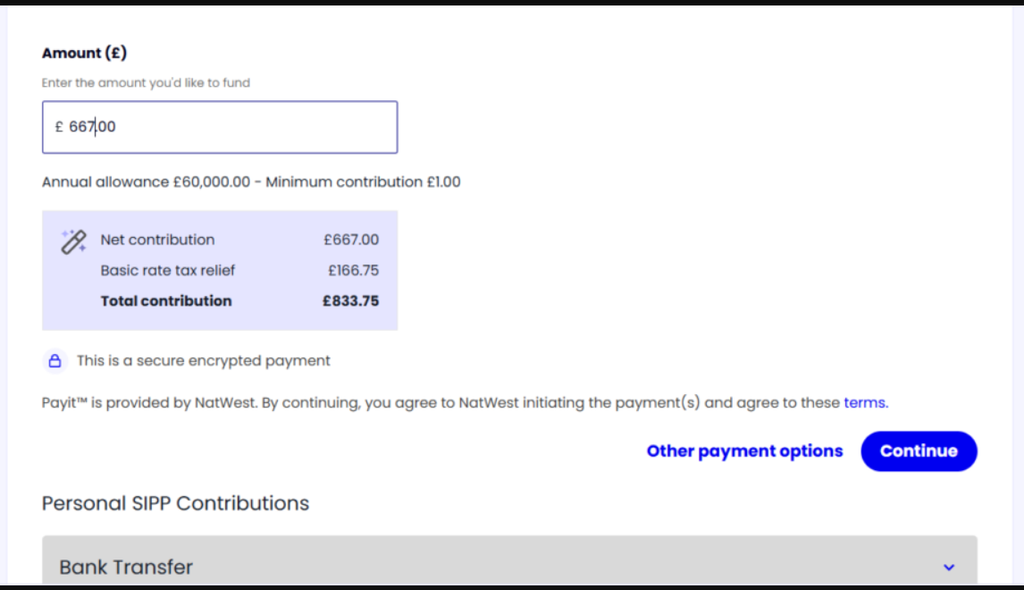
Pension tax relief made sense to me the moment I saw it on my own screen. When I paid into my SIPP this summer, I typed £667 into the box on Interactive Investor, and it showed £833.75 going into my pension. The extra £166.75 was the government’s money, added because I’d already paid tax on what I put in.
That part happens on its own. What surprised me, once I started digging, is how many women are owed more than that and never get it. Some are higher rate taxpayers who never claim the second half of their relief. Some are low earners whose workplace scheme gave them nothing for years. And some aren’t earning at all, during a career break or while caring for someone, and have no idea the 20% is still available to them.
This guide walks through all three, with real numbers, so you can check whether any of that money is yours.
What’s in this post
What is pension tax relief? The short answer
Pension tax relief is the government topping up your pension with the income tax you’d otherwise have paid on that money. For a basic rate taxpayer, £80 from you becomes £100 in your pension. Higher and additional rate taxpayers can get more, but usually have to claim the extra themselves.
How does pension tax relief work?
You get relief at your highest rate of income tax, on contributions up to 100% of your annual earnings, according to gov.uk’s guide to tax relief on private pensions. In England, Wales and Northern Ireland, that works out like this for every £100 that lands in your pension.
| Your tax band (2026/27) | Taxable income | You pay | Relief | Goes into your pension |
| Basic rate (20%) | £12,571 to £50,270 | £80 | £20 | £100 |
| Higher rate (40%) | £50,271 to £125,140 | £60 | £40 | £100 |
| Additional rate (45%) | Over £125,140 | £55 | £45 | £100 |
Bands from gov.uk’s Income Tax rates page.
That basic rate line is a 25% boost on your own money, before your investments have done a thing.
If you live in Scotland, the rates are different. You can claim an extra 1% if you pay the 21% intermediate rate, 22% at the 42% higher rate, 25% at the 45% advanced rate and 28% at the 48% top rate. If you pay the 19% starter rate, your provider still claims 20% and you don’t have to pay the difference back. The bands are on gov.uk’s Income Tax in Scotland page.
Relief at source vs net pay: why it matters if you earn less
Your pension gets its relief in one of two ways, and which one your scheme uses changes what you need to do.
| Relief at source | Net pay arrangement | |
| How you pay | From your take home pay, after tax | From your salary, before tax is worked out |
| Who adds the relief | Your provider claims 20% from HMRC and adds it to your pot | It happens in payroll, because you simply pay less tax |
| Who uses it | SIPPs, personal pensions, many workplace schemes | Many workplace schemes, including some public sector ones |
| Higher rate taxpayers | Claim the extra themselves | Get full relief automatically |
| Non taxpayers | Still get 20% added | Got nothing in payroll (see below) |
For most people, net pay is the easier one. But if you earned less than the £12,570 Personal Allowance, you paid no income tax, so there was no tax to save. Someone on the same pay in a relief at source scheme got 20% added anyway. For years, that gap was simply lost.
That’s now changed. From the 2024/25 tax year onwards, HMRC is paying a Low Earner’s Pension Payment to people in this position, worth the relief they would have had under relief at source. HMRC’s August 2026 pension schemes newsletter confirms it applies from 2024/25, with eligibility checked each year. HMRC is writing to around a million people between late 2026 and early 2027, and MoneySavingExpert reports the average payment for 2024/25 is about £70.
This one matters for us in particular. HMRC’s own policy paper estimates that women are 75% of the people earning below the Personal Allowance in net pay schemes. It fits a wider pattern, too: 66% of workers earning under the £10,000 auto enrolment threshold are women, one of the figures I pulled together on the UK gender pension gap.
Two things to know. The money is paid to you, not into your pension, and you accept it by giving HMRC your bank details through your Personal Tax Account (or by phone if you don’t have one). And because scammers love a “you’re owed money” message, it’s worth knowing that HMRC contacts you about this by letter or through your Personal Tax Account, not by call, text or email. Check any letter against gov.uk’s guidance on genuine HMRC contact before you act on it.
SIPP tax relief: how and when it’s added
A SIPP always uses relief at source. You pay in from money you’ve already been taxed on, and the provider claims the basic 20% back from HMRC for you. If you’re new to them, I’ve explained what a SIPP is and how it works in plain English.
The relief isn’t instant. Interactive Investor’s SIPP tax relief page says it usually takes 6 to 11 weeks to arrive from HMRC, and that matches my own account, where the relief lands in my SIPP’s cash weeks after I pay in. It arrives as cash, not as extra investments, so it needs investing too, or it just sits there.
If you’re self employed, a SIPP or personal pension is how you get relief, because there’s no employer scheme doing it for you. Your provider adds the 20% in exactly the same way, and relief is limited to 100% of your earnings. You’re almost certainly filing a Self Assessment return already, which makes claiming any higher rate relief simpler than it is for employees.
How to claim higher rate tax relief on pension contributions
This is where real money gets left behind. If you pay 40% or 45% tax and your pension uses relief at source, only the first 20% is added for you. The rest you claim from HMRC.
If you file a Self Assessment return, you claim on the return, for the current year and any previous years.
If you don’t file a return, you can use HMRC’s online service to claim tax relief on private pension payments (or write to HMRC if you can’t claim online). That service is for the current tax year, through your tax code. You’ll need your National Insurance number, your provider’s name, the net amount you paid in each year and proof, such as a statement from your provider. HMRC says it aims to contact you within 28 working days.
A worked example. Sarah lives in England and earns £60,000. She pays £4,000 into her SIPP, and her provider adds £1,000, so £5,000 goes into her pension.
- £9,730 of her income (everything above £50,270) is taxed at 40%, which covers the whole £5,000.
- She can claim an extra 20% of £5,000, which is £1,000 back from HMRC.
- Total relief is £2,000. A £5,000 contribution has cost her £3,000.
If she never claims, she pays £4,000 for that same £5,000. That £1,000 is the gap, and it’s there every single year she doesn’t claim.
Do pension contributions reduce your taxable income?
If you earn over £100,000, there’s an extra boost. Normally, the first £12,570 you earn is tax free. That’s your Personal Allowance. Once your income goes over £100,000, HMRC starts taking it away, £1 for every £2 you earn above £100,000, until it’s gone completely at £125,140.
Paying into a pension can win it back. Before HMRC checks whether you’re over £100,000, it takes your pension contributions off your income (it calls what’s left your adjusted net income). For a SIPP, it takes off the full amount that goes in, including the 20% your provider adds, as gov.uk’s adjusted net income rules explain.
Say you earn £110,000.
You’re £10,000 over the line, so you’ve lost £5,000 of your Personal Allowance.
You pay £8,000 into your SIPP. Your provider adds £2,000, so £10,000 goes in.
HMRC now counts your income as £100,000, so you get the whole £5,000 allowance back.
Then add up what comes back to you:
£2,000 added by your provider
£2,000 of extra higher rate relief, claimed from HMRC
£2,000 less tax, because that £5,000 of your income is tax free again
That’s £6,000 back on a £10,000 contribution, which is why you’ll hear it called 60% relief. You have £10,000 in your pension, and it’s cost you £4,000.
Tax relief if you don’t earn, or earn very little
You don’t need a salary to get relief on your pension. If you have no earnings, you can still pay up to £2,880 a year into a relief at source pension such as a SIPP, and the provider adds 20%, so £3,600 goes in. If you earn a little, you can pay in up to your earnings, or £3,600 gross if that’s higher. The gov.uk relief page covers the no earnings limit, and I’ve gone through the £3,600 rule in more detail in my guide to the pension annual allowance.
This one is personal. At 36 I took a four year career break and paid nothing into a pension during it, then worked part time for three more years. Over those four years without a salary, £2,880 a year could have become £14,400 in my pension before any growth at all. If you’re on a break now, this is one of the few pension boosts that doesn’t depend on a pay packet, and a partner or parent can pay it in for you.
Claiming tax relief on pension contributions for previous years
If you’ve been a higher rate taxpayer for a while and never claimed, you can usually go back four tax years. HMRC’s Self Assessment Claims Manual sets the limit at four years after the end of the tax year concerned. In practice, that means 2022/23 is the oldest year you can still claim for, and that window closes on 5 April 2027.
Go back to Sarah. Four missed years at £1,000 each is £4,000, which is a lot of money to leave with HMRC. If you file a return, you’d amend it or write to HMRC for the older years. If you don’t, HMRC’s October 2026 pension schemes newsletter describes a new gov.uk tool, “check how to claim a tax refund on your pension”, which asks you a few questions and sends you to the right form.
The limits on tax relief
Relief isn’t unlimited. Most people can pay in up to £60,000 a year (including employer contributions), capped at 100% of their earnings for tax relief purposes. If you’ve already taken money flexibly from a pension, the limit drops to £10,000, which I’ve covered in my post on the money purchase annual allowance. The full rules, including carry forward, are in the annual allowance guide I linked above.
The relief also isn’t the whole story. You get it on the way in, but 75% of what you take out later is taxed as income, so it’s partly tax deferred rather than tax gone. I’ve weighed that up in SIPP vs ISA and in whether pensions are worth it.
What about salary sacrifice?
Salary sacrifice is when you give up part of your salary and your employer pays it into your pension instead, so you save National Insurance as well as tax. It works differently enough, with changes coming in 2029, that it’s getting a post of its own, coming soon.
FAQs
Do I get tax relief on employer contributions?
There’s nothing for you to claim. Your employer’s contributions go into your pension in full, on top of your pay, rather than coming out of income you’ve been taxed on. They do count towards your £60,000 annual allowance alongside your own contributions. This is one reason a workplace pension usually comes first: your employer’s money is the one boost that doesn’t depend on you claiming anything.
Can I pay more into my pension to avoid 40% tax?
You can reduce how much of your income is taxed at 40%. With relief at source, every gross pound you pay in stretches your basic rate band, so income that would have been taxed at 40% is taxed at 20% instead. You still have to claim that extra relief. Over £100,000, contributions can also win back Personal Allowance, giving an effective 60% relief. Remember the money is locked away until 55, rising to 57 from April 2028 under current rules.
When does SIPP tax relief arrive?
Your provider claims the basic 20% from HMRC after you pay in, so it isn’t instant. Interactive Investor says it usually takes 6 to 11 weeks, and in my own SIPP it arrives as cash that I then invest. Other providers have their own timings, so check their help pages. Any higher rate relief comes separately, from HMRC, through your tax return or tax code.
Is there a deadline to claim?
You can usually claim for up to four tax years after the end of the year you paid in. At the time of writing, the oldest year still open is 2022/23, and the deadline for that year is 5 April 2027. Basic rate relief on a relief at source pension is claimed for you, so the deadline mainly matters for higher and additional rate taxpayers who haven’t claimed the extra.
Do pensioners get tax relief?
Yes, if you’re under 75. You can pay in up to 100% of your earnings, or £2,880 net (£3,600 gross) if you have little or no earnings, and get relief. Pension income doesn’t count as earnings for this. Once you’ve taken money flexibly from a pension, your limit drops to £10,000 a year. From 75, tax relief on new contributions stops.
Did the 2026 Budget change pension tax relief?
No. The 28 October 2026 Budget left relief at your marginal rate, as it was. HMRC’s Budget newsletter (the same one linked above) lists other pension changes, such as the inheritance tax rules for pensions from April 2027, but nothing on relief rates. Cutting higher rate relief is a perennial Budget rumour, though, so check gov.uk again before each new tax year.
The relief added to your pension when you pay in is the easy part. The money women tend to miss is everything after that: the higher rate claim nobody reminds you about, the HMRC letter that looks like a scam, and the £2,880 you can pay in when you aren’t earning. Rules change, so always check current figures before acting.

Angelina is the founder of Investing Adventures, where she helps women build confidence with money and investing. With seven years of personal investing experience, she breaks down complex financial topics into practical, actionable advice. Her mission is simple: to help more women take the driver’s seat in their financial future.
I am not a financial advisor and nothing in this post constitutes financial advice. All investments carry risk and the value of your investments can go down as well as up. Please do your own research and consider seeking independent financial advice before making any investment decisions.