
I am not a financial advisor and nothing in this post constitutes financial advice. All investments carry risk and the value of your investments can go down as well as up. Please do your own research and consider seeking independent financial advice before making any investment decisions.
SIPP. It’s an ugly little acronym, isn’t it, sounds like something that requires a finance degree, a spreadsheet habit, and possibly a solicitor. It sounds complicated.
It’s not. And I can prove it, because seven years ago I built one myself with no financial background whatsoever.
I’m Angelina. When I was 45 I had three old pension pots scattered across three different providers, some of them barely remembered, dug out from old statements and paperwork. I gathered all three into a single SIPP, chose my own investments, and that account is now the most important one I own. My retirement lives in it.
So in this guide I’m going to explain exactly what a SIPP is and how it works, in plain English, with real examples from my own account. Not theory. Actual numbers from my actual pension. By the end you’ll understand this better than most of the people who nod along when the acronym comes up at dinner parties.
Let’s get into it.
Table of Contents
What is a SIPP?
SIPP stands for Self Invested Personal Pension. That’s it. That’s the whole mystery.
Break it into its parts and it explains itself. It’s a pension, so it’s money locked away for your retirement with generous tax treatment on the way in. It’s personal, so it belongs to you, not to any employer or pension provider, and it follows you whatever happens with work. And it’s self invested, which is the important bit: you choose what the money inside is invested in, rather than an employer or a pension company choosing for you.
Compare that with a workplace pension. In a workplace pension, your money typically goes into a default fund chosen by the scheme, and most people never look at it again. Nothing wrong with that, it’s how millions of people save for retirement perfectly well. But you didn’t choose it, and you may not even know what’s in it.
A SIPP hands you the steering wheel. The control, and the responsibility, sit with you.
How does a SIPP work?
Here’s the whole lifecycle of a SIPP, start to finish.
You open one. With an FCA regulated platform, online, and it genuinely takes minutes. More on choosing where later.
You put money in. Either as lump sums, or as a regular monthly contribution, or by transferring in old pensions you already have. I did all three. When I opened mine, my first move was consolidating those three forgotten pension pots into it. The transfers took a few weeks and the effort of digging out the old paperwork was entirely worth it, because everything now lives in one place where I can actually see it.
The government tops it up. This is tax relief, and it’s the single best thing about a SIPP. It gets its own section below because it deserves one.
You choose the investments. Funds, shares, whatever suits you. The money doesn’t just sit there as cash, or at least it shouldn’t. It gets put to work.
It grows, sheltered from tax. No capital gains tax, no dividend tax on anything inside the SIPP wrapper. Your investments compound away undisturbed for years, which is exactly what long term money should be doing.
You access it from age 55, rising to 57 in 2028. Under current rules you can normally take 25% as a tax free lump sum, with the rest taxed as income when you draw it. For my cohort, that access age is 57, because my SIPP doesn’t have a protected pension age. Some people can still take theirs at 55, and whether you can take your pension at 55 depends on when you reach it and your scheme’s rules.
That last point is worth pausing on, because it scared me at first. The money in a SIPP is locked. You cannot dip into it, whatever comes up. In the beginning that felt like a bug. It took me a while to realise it’s the feature. A SIPP is a locked box for future you, and the lock is precisely why the money actually grows. Every account I could reach, I raided. The one I couldn’t touch is the one that flourished. And if handing your retirement over to a locked box leaves you asking is my pension safe, I’ve answered that properly, protections and limits included.
SIPP tax relief explained
If you remember one section from this post, make it this one. Tax relief is the reason a SIPP beats almost any other place you could put long term money, and I can show you exactly what it looks like because it happens in my account every month.
Here is a real contribution of mine.
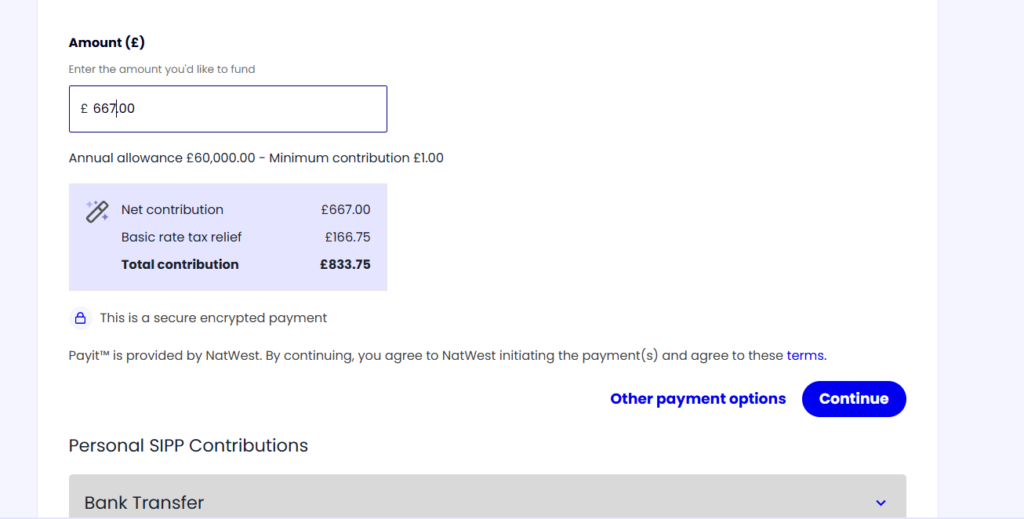
I paid in £667. What actually landed in my pension was £833.75.
The difference, £166.75, is basic rate tax relief. The government added it. I did nothing to make that happen, filled in no forms, chased nobody. My platform claimed it on my behalf and a few weeks later it simply appeared.
Here’s the plain English version of what’s going on. The money you earn gets taxed before it reaches you. When you put some of it into a pension, the government gives that tax back. At the basic rate of 20%, the maths works out so that every £80 you contribute becomes £100 in your pension. That’s a 25% uplift on every single pound you pay in, before your investments have grown by a penny.
Let that sit for a second. Where else does your money grow by 25% the moment it arrives?
If you pay higher rate tax, there’s more. The 20% is added automatically, but higher and additional rate taxpayers can claim extra relief on top through their self assessment tax return. And here’s the bit that catches people out: that extra relief is not automatic. You have to claim it. Plenty of higher rate taxpayers never do, and leave real money sitting unclaimed with HMRC year after year. If that’s you, please don’t leave it on the table.
One honest caveat. The figures above apply to taxpayers in England, Wales and Northern Ireland. Scotland has its own income tax bands and rates, so if you’re a Scottish taxpayer the relief works slightly differently at some income levels. Most guides never mention this. It matters, so check what applies to you.
All figures correct at the time of writing, and always worth verifying against current rules before you contribute.
Who can open a SIPP?
Almost anyone. Employed, self employed, between jobs, not working at all. You do not need an employer, a salary, or anyone’s permission.
How much you can pay in. Under current rules you can contribute up to 100% of your earnings each tax year and receive tax relief, up to the annual allowance of £60,000. If you have little or no earnings, you can still pay in up to £3,600 a year including the tax relief. So a non earner contributes £2,880, the government adds £720, and £3,600 goes into the pension. Even without a wage coming in, the uplift still applies.
Carry forward. If you haven’t used your full annual allowance in the previous three tax years, you may be able to carry the unused portion forward and contribute more in the current year. Useful if a lump sum arrives, an inheritance say, or a good year of self employment.
The age 75 rule, explained properly. You’ll often read that you can’t have a SIPP after 75. That’s not quite right. What actually stops at 75 is the tax relief on new contributions. The account itself carries on. It’s a distinction most guides blur, and it changes how you’d plan the later years.
And if you are wondering what happens to any of this, or to an ISA, when you die, I cover the inheritance tax rules properly in my ISA inheritance tax guide, and the SIPP side, including the change from 6 April 2027, in my post on SIPP inheritance tax.
What can you invest in through a SIPP?
The menu is wide: funds, individual shares, ETFs, investment trusts, and more depending on the platform.
For most of us, the honest answer is much simpler than the menu suggests: low cost index tracker funds. One fund holding hundreds or thousands of companies, charging a fraction of a percent, left alone for years. That’s my entire SIPP strategy. I hold index trackers, I contribute monthly, and I check the account once every two months on desktop, having deleted the app years ago to stop myself fiddling.
If index funds are a new idea, or you want the full picture on what investing actually involves before you commit a penny, my How To Start Investing In The UK guide walks through all of it from the very beginning. The short version: you don’t need to be a stock picker to run your own pension. You need one sensible fund and the discipline to leave it alone.
SIPP vs workplace pension: which comes first?
If you’re employed and your employer offers a pension, that comes first. Not because a workplace pension is better, but because your employer pays into it alongside you, and that employer contribution is free money that a SIPP simply doesn’t come with. Opting out of a workplace pension to fund a SIPP instead means walking away from money your employer would have given you.
For most people the two work together rather than compete. The workplace pension collects the employer contributions. The SIPP holds the old pensions from previous jobs, takes any extra you want to contribute beyond the workplace scheme, and gives you a corner of your retirement that you fully control and fully understand.
That’s the arrangement I’d think of as normal. A SIPP complements a workplace pension. It doesn’t replace it.
If you’re self employed, the calculation changes completely. There’s no employer and no workplace scheme, so a SIPP (or another personal pension) isn’t a nice extra. It’s the whole plan. If you’re curious how your own pot compares with other people your age, the average UK pension pot by age gives you a fair yardstick.
What is a Junior SIPP?
A Junior SIPP is exactly what it sounds like: a pension for a child. A parent or guardian opens it, anyone can pay into it, and the child takes control at 18, though they can’t access the money until their own retirement age.
Under current rules, up to £3,600 a year can go in, on the same terms as a non earner. You contribute £2,880, the government adds £720 in tax relief, and £3,600 lands in the pension. Yes, the government pays tax relief into a pension for a child who has never paid a penny of tax. It’s one of the quiet oddities of the system, and it’s real.
Now think about what that money has that no other money in the family has: time. A pension started at birth has close to six decades to compound before it can even be touched. Every pound in it gets the longest possible run. You will never again be able to give money that much time to work.
Is a Junior SIPP right for every family? Honestly, no. The money is locked away for the better part of a lifetime, and most families have nearer term needs for their children, university, a house deposit, that a Junior ISA serves far better because it’s accessible at 18. I chose Junior ISAs for my own two children for exactly that reason. But if the nearer term is already covered and you want to do something remarkable with a spare £25-50 a month, a Junior SIPP is one of the most powerful gifts it’s possible to give.
How to open a SIPP
The practical steps, in order.
- Choose an FCA regulated platform. Check the regulation, check that investments are protected by the Financial Services Compensation Scheme, and compare the fees, because platforms charge either a flat fee or a percentage of your pot and the difference compounds over decades. My Hargreaves Lansdown review lays out exactly how a percentage fee behaves as a pot grows, and why that structure matters more the longer you hold it. Or if a zero fee ISA is more your speed, I’ve written a full breakdown of whether Trading 212 is safe to use.
- Open the account online. Expect it to take minutes, not days. You’ll need your National Insurance number and the usual identity details.
- Fund it. Set up a monthly contribution, add a lump sum, or start the process of transferring in old pensions. If you’re consolidating, dig out the paperwork for every old pot first. Tedious but worth it.
- Choose your investments. Don’t leave the money sitting in cash. Pick your fund and put the money to work.
- Then leave it alone. The hardest step and the most important one.
I use Interactive Investor for mine, and have done for seven years across five accounts. My Interactive Investor Review covers the full experience, including what consolidating my three old pensions was actually like and how the platform claims my tax relief automatically. It’s not the only good platform out there, but it’s the one I chose and would choose again.
FAQ
Is it worth putting money in a SIPP?
For long term retirement money, the case is strong. Tax relief turns every £80 you contribute into £100 before any growth happens, investments grow free of capital gains and dividend tax, and the money is locked away where you can’t raid it. The trade off is exactly that lock: nothing goes back out until at least 55, rising to 57 in 2028. If you might need the money sooner, it doesn’t belong in a SIPP.
What are the disadvantages of a SIPP?
Three main ones. The money is inaccessible until at least 55, rising to 57, whatever life throws at you. The investment decisions and their consequences are entirely yours, which suits some people and unsettles others. And withdrawals beyond the 25% tax free lump sum are taxed as income, which is usually the first cost people think of when taking your pension at 55. A SIPP rewards people who want control and punishes nobody, but it does demand that you engage with it rather than ignore it.
Is it better to have a SIPP or an ISA?
They do different jobs. A SIPP gives you tax relief on the way in and locks the money until at least 55, rising to 57. An ISA gives no upfront relief but stays accessible, with withdrawals tax free. Retirement money suits the SIPP, everything nearer term suits the ISA, and many of us hold both. My own monthly contributions now go to my SIPP precisely because I proved I couldn’t leave an accessible account alone.
I set out the full framework in my SIPP vs ISA guide.
Is a SIPP better than a personal pension?
A SIPP is a type of personal pension. The difference is who chooses the investments. In a standard personal pension, the provider manages the money, usually in a default fund. In a SIPP, you choose from a much wider range yourself. Neither is automatically better. If you want to pick your own low cost funds and keep charges down, a SIPP wins. If you’d rather never think about it, a managed personal pension may suit you better.
Can I have a SIPP and a workplace pension?
Yes, and for most employed people that’s the sensible arrangement. Stay in the workplace pension for the employer contributions, because that’s money you don’t get any other way, and run a SIPP alongside it for old pensions from previous jobs and any extra contributions. Your annual allowance covers everything you and your employers pay in combined across all your pensions, so keep an eye on the total.
What are the SIPP pension rules?
The essentials under current rules: contribute up to 100% of earnings each year with tax relief, capped by the £60,000 annual allowance, or £3,600 if you have no earnings. Basic rate relief is added automatically, higher rate relief is claimed via self assessment. Access begins at 55, rising to 57 in 2028, with 25% normally available tax free and the rest taxed as income. Rules change, so always check current figures before acting.

Angelina is the founder of Investing Adventures, where she helps women build confidence with money and investing. With seven years of personal investing experience, she breaks down complex financial topics into practical, actionable advice. Her mission is simple: to help more women take the driver’s seat in their financial future.
I am not a financial advisor and nothing in this post constitutes financial advice. All investments carry risk and the value of your investments can go down as well as up. Please do your own research and consider seeking independent financial advice before making any investment decisions.