
I am not a financial advisor and nothing in this post constitutes financial advice. All investments carry risk and the value of your investments can go down as well as up. Please do your own research and consider seeking independent financial advice before making any investment decisions.
There’s a specific moment I want to name, because I’ve been in it. The bills are paid, there’s a bit left over, and you know it should be doing something better than sitting in a current account earning nothing. You’ve heard of ISAs. You’ve heard of SIPPs. And you genuinely do not know which one deserves your money, or whether you’re supposed to be feeding both.
So you do nothing. The money stays where it is. Another month passes.
I’m Angelina. I’ve held both a SIPP and an ISA for years, on the same platform, alongside a Trading Account and two Junior ISAs for my children. So when I talk about the SIPP vs ISA decision, I’m not talking about it from a diagram. I’m talking about it from seven years of actually living with both accounts, watching both grow, and learning the hard way what each one is genuinely for.
Most guides on this answer the question with “it depends” and leave you exactly where you started. I’m not going to do that. I’m going to give you a proper framework, built around your actual situation, so that by the end of this you’ll know which account should get your money first, second, and why.
Let’s get into it.
Table of Contents
The short answer, before anything else
I’m not going to bury this at the bottom, because it’s the thing you actually came for.
For most women reading this, it is rarely a case of one or the other. It’s a case of which account gets which money, and in which order.
Here’s the honest headline. A SIPP wins on tax relief, because the government tops up everything you pay in, but it locks your money away until at least 57 under current rules. An ISA wins on flexibility, because you can reach the money whenever you like, but you get no upfront boost on the way in. Different strengths. Different jobs.
Most people benefit from holding both, in a sensible priority order I’ll walk you through further down. But if you take nothing else from this post, take this: the SIPP is for money you’re confident you won’t need until retirement, and the ISA is for everything sitting between now and then. Get that distinction straight and the rest becomes far easier.
Now let me unpack it properly.
What is a SIPP, in one paragraph
A SIPP is a Self Invested Personal Pension. It’s a pension you run yourself, choosing your own investments, rather than one an employer or an insurance company manages for you. The mechanic that matters is tax relief. Pay into a SIPP and the government adds 20% basic rate relief on top automatically, with higher rate taxpayers able to claim more through self assessment. In return for that generosity, the money is locked until you reach the minimum pension age, currently 55 and rising to 57 from April 2028 under current rules. I’ve written a full plain English breakdown of how it all works in my What Is A SIPP guide if you want the deep dive.
What is an ISA, in one paragraph
An ISA is an Individual Savings Account, which is simply a tax wrapper. Anything you hold inside it grows free of capital gains tax and dividend tax, and every penny you take out comes back to you completely tax free, whenever you want it. There’s no government top up on the way in, because you’re paying in from money you’ve already been taxed on. When people talk about an ISA for investing, they usually mean a Stocks and Shares ISA, which holds funds and shares rather than cash. If you’re weighing that up against a savings version, I go through it properly in my Cash ISA vs Stocks and Shares ISA post, and if you’re ready to pick a platform, my guide to the best Stocks and Shares ISA in the UK compares the main ones. And if you’re wondering whether the whole thing is worth doing in the first place, I’ve made the honest case in are ISAs worth it.
SIPP vs Stocks and Shares ISA: the key differences side by side
Here is the whole thing in one place. This is the comparison most people are really after, so I’ve laid the SIPP and the Stocks and Shares ISA out against each other on the dimensions that actually change your decision.
| SIPP | Stocks and Shares ISA | |
| Tax relief on the way in | 20% added automatically, more for higher and additional rate taxpayers via self assessment | None. You pay in from income you’ve already been taxed on |
| Tax on the way out | 25% tax free, the remaining 75% taxed as income at your rate when you draw it | Nothing. All withdrawals are completely tax free |
| Access age | 55, rising to 57 from April 2028 under current rules | Any time |
| Flexibility | Locked until access age, with no early access except in narrow cases like serious ill health | Withdraw whenever you like, for any reason |
| Annual allowance | Up to £60,000 or 100% of your earnings, whichever is lower, and £3,600 if you have little or no earnings. Unused allowance can be carried forward up to three years | £20,000 a year across all your ISAs combined |
| What happens on death | Currently favourable, though from April 2027 most unused pension funds are due to come into inheritance tax under current government plans. Money passing to a spouse or civil partner stays exempt | Forms part of your estate for inheritance tax, though a spouse can inherit the tax free status |
| Best use | Retirement money you’re confident you won’t need until at least 57 | Medium term goals and any money you might need before retirement |
Allowances and rules correct at the time of writing and can change. Always check the current figures before acting.
Two rows in that table do most of the deciding: tax relief on the way in, and access age. Everything else is detail around those two. So let me take them one at a time, honestly, because each account genuinely wins one of them.
The tax question: where the SIPP pulls ahead
This is where the SIPP earns its keep, and it’s the decisive point in the whole pension vs ISA question.
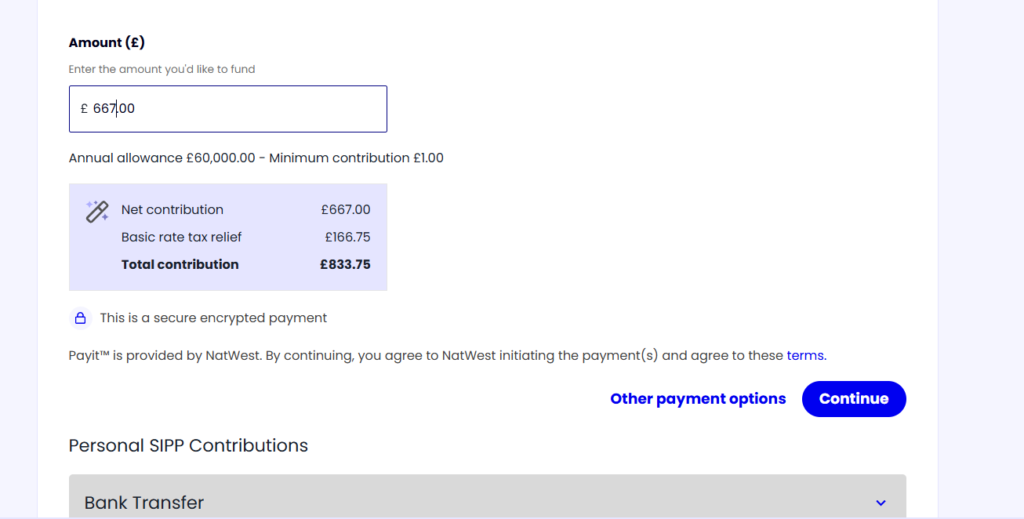
When you pay into a SIPP, the government tops it up. Pay in £667.00 and basic rate relief turns it into £833.75 inside the pension, with the extra £166.75 landing automatically a few weeks later. You did nothing to claim it. On my own SIPP, that 20% rebate simply appears in my cash wallet six to eleven weeks after I contribute, and I’ve never once had to chase it.
The screenshots below are from within my own SIPP account, so you can see how it works in action.
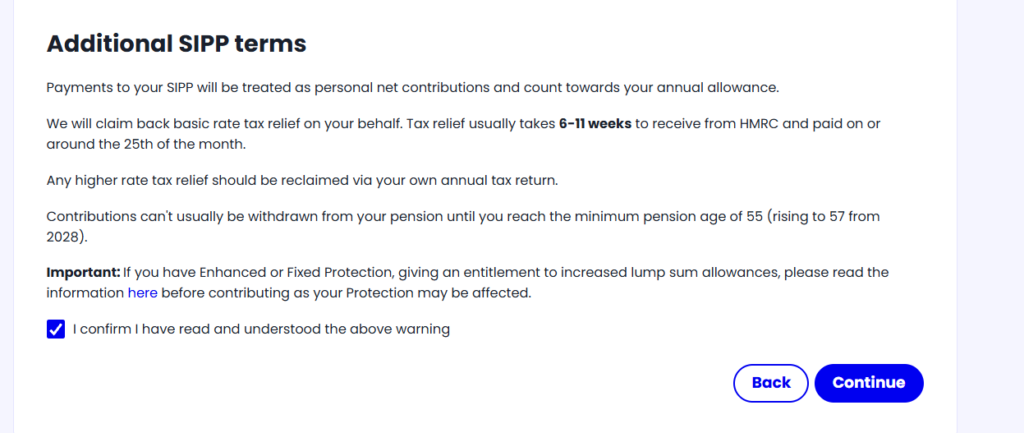
If you’re a higher rate taxpayer, there’s more to claim through your tax return, and you genuinely should, because that’s your money sitting on the table.
An ISA gives you none of that. You pay in from taxed income and there’s no boost. So on the way in, the SIPP wins, clearly and every time.
But here’s the part most guides quietly skip, and I won’t, because honesty is the whole point of this blog.
That tax relief is not entirely free money. It’s more like deferred tax. When you eventually draw your SIPP, the first 25% comes out tax free, but the remaining 75% is taxed as income at whatever your rate is at the time. You’ll see comparison tables all over the internet showing a SIPP growing to some enormous figure next to a smaller ISA, and almost none of them net the pension down for the tax you’ll pay on that 75% when you withdraw it. That makes the SIPP look better than it really is.
The real picture is more balanced. The SIPP still usually comes out ahead, because getting tax relief now and paying some tax later tends to beat paying full tax now, especially if you drop into a lower tax band in retirement than you’re in today. But it’s an advantage, not the landslide those headline numbers pretend it is.
And two honest caveats sit underneath it. Frozen tax thresholds mean more people are being pulled into higher bands over time, not fewer. And your pension income doesn’t arrive in a vacuum, it stacks on top of your State Pension, which for a full new State Pension is already about £12,548 a year. Both of those chip away at how much of that 75% you actually keep.
None of this is a reason to avoid a SIPP. I hold one and it’s the most important account I own. It’s a reason to understand what you’re actually getting, which is a very good deal, not a magic bullet.
The flexibility question: where the ISA pulls ahead
Now the other side, because the ISA wins its table row just as clearly.
Money in a SIPP is gone until you’re at least 57. That is the entire design, and I’ll be honest, it frightened me when I opened mine. Locking money away where I couldn’t reach it felt like too big a commitment. What I didn’t understand at first was that the lock is the feature, not the flaw. It stops you raiding your own retirement. And if locking money away for decades makes you wonder whether your pension is safe while it sits there, I’ve covered exactly that in its own post.
A ISA is the opposite. The money stays reachable. You can take it out next week, next year, or in fifteen years, tax free, no questions asked, no penalties. That makes it the right home for anything you might genuinely need before retirement. A house move. A gap between jobs. Helping a child. A plan that hasn’t even taken shape yet.
I made a mistake with this one, and it went the wrong direction. For a long time I kept my spare money in my Stocks and Shares ISA and treated it exactly like a Cash ISA savings account, dipping in whenever something came up. It never had a chance to grow, because I never left it alone. That’s the flip side of flexibility. If you’re using an ISA as your long term investing home, make sure it’s a Stocks and Shares ISA and you have the discipline to leave it alone!
So the scorecard is simple. SIPP wins on tax. ISA wins on access. Which is exactly why, for most people, the answer isn’t to choose between them. It’s to use each for the job it’s built for.
So which should you choose? A framework by situation
Here’s where it gets practical, because the right answer genuinely changes depending on where you’re standing. Find yourself below.
If you already have a workplace pension
Start here, and start with the free money, because almost every other guide on this topic forgets to mention it.
If you’re employed and your workplace pension comes with employer matching, that match is the best return available to you anywhere. Your employer is effectively adding free money to your retirement on top of your own contribution and the tax relief. No SIPP and no ISA can compete with that, because nothing else pays you simply for paying in.
So the order is clear. Contribute enough to your workplace pension to capture the full employer match first. Only once you’ve claimed every pound of that match does the SIPP vs ISA question even begin. A SIPP can then be a good home for extra pension money on top of your workplace scheme or old previous workplace pensions, but the match comes first, always.
If you’re self employed
No employer, no match, no workplace scheme quietly building in the background. It’s all on you, which means the SIPP vs ISA decision carries more weight.
Here the SIPP becomes genuinely valuable, because that automatic tax relief is the closest thing you have to an employer top up. It’s the boost nobody else is giving you. A sensible approach for many self employed women is a SIPP for the long term retirement money, benefiting from the relief, alongside an ISA for flexibility, because self employed income is often lumpier and having accessible money matters more when there’s no salary landing on the same day each month.
If you might need the money before 57
Then the ISA wins by default, and it isn’t close.
There’s no point earning tax relief on money you’re going to need in five years, because you simply can’t get it out of a SIPP when that day comes. Locking money away you’ll need before retirement isn’t clever, it’s a trap you build for yourself. If there’s any real chance you’ll want this money before your late fifties, it belongs in an ISA, full stop. The tax relief is only worth having if you can afford to leave the money completely alone for the long haul.
Junior SIPP vs Junior ISA: investing for children
If you’re investing for a child, the same logic scales down, and the two accounts split cleanly.
A Junior ISA gives the child access to the money at 18, when it becomes fully theirs to do with as they wish. A Junior SIPP locks it away for their retirement, decades further out, but with the same tax relief a grown up SIPP gets, so even a small contribution is topped up by the government. Most parents and grandparents lean toward the Junior ISA for its flexibility, and it’s usually the more practical starting point, not least because far fewer providers offer a Junior SIPP at all.
I hold two Junior ISAs myself. My father gifted money to my two children and asked me to put it somewhere sensible, and I invested it in the same index tracker funds working inside my own SIPP. The Junior ISA basics sit inside my beginner’s guide if you want them.
Can you have both? Yes, and the right order
Yes. And most people should.
Holding both a SIPP and an ISA isn’t greedy or complicated, it’s how you cover both bases at once. Retirement money in the pension, doing the tax efficient long term work. Nearer term money in the ISA, staying reachable. I’ve run both alongside each other for years and it’s made my financial life more manageable, not less.
The sensible priority order, for most people, goes like this.
- Workplace pension up to the full employer match. The free money first, before anything else.
- Clear any high interest debt and build an emergency fund. Investing on top of expensive debt rarely makes sense.
- Then choose between extra SIPP and ISA based on the money’s job. If it’s money you’re confident you won’t touch until retirement, the SIPP and its tax relief usually win. If there’s any chance you’ll need it sooner, the ISA and its flexibility win.
That third step is the real SIPP or ISA first question, and there isn’t a single answer, because it depends entirely on the money, not on the account. Ask what each pound is for. That tells you where it goes. And once your £20,000 ISA allowance is used for the year, there’s a third home worth knowing about, which I compare properly in general investment account vs ISA.
One practical point worth naming, because it’s what tips real portfolios one way or the other over time. The platform fee you pay to hold these accounts matters more than people think, especially once you hold more than one. On a percentage fee platform, the charge climbs on every account as each grows, which is exactly the trap I dug into in my Hargreaves Lansdown review. On a flat fee platform, holding both a SIPP and an ISA under one charge can work out considerably cheaper as your money grows, which is a big part of why I’ve stayed where I am, as I explain in my Interactive Investor review. Do the maths for your own situation before committing to either model.
FAQ
Is it better to pay into a SIPP or ISA?
It depends on when you’ll need the money. A SIPP gives you tax relief on the way in but locks the money until at least 57, so it wins for pure retirement saving. An ISA gives no upfront boost but stays completely accessible and tax free on withdrawal, so it wins for anything you might need sooner. Most people are best served by holding both and matching each pound to the account that suits its timescale.
Is it better to save into an ISA or pension?
For most employed people the honest order in the ISA vs pension question is: workplace pension up to the full employer match first, because that free money beats everything, then decide between extra pension contributions and an ISA based on the money’s job. A pension wins on tax relief for genuinely long term money. An ISA wins on flexibility for anything you might need before retirement. It’s rarely one or the other, it’s which gets your money first.
What are the downsides of SIPPs?
The main one is access. Your money is locked until at least 57, with no early withdrawals except in narrow cases. The 75% above your tax free lump sum is taxed as income when you draw it. And once you start flexibly taking taxable income, the amount you can keep paying in with tax relief drops sharply under the Money Purchase Annual Allowance. A SIPP is also self directed, so the investment decisions, and the responsibility, sit with you.
What is the 3 year rule for SIPP?
It usually refers to carry forward. If you didn’t use your full pension annual allowance in the previous three tax years, you can carry that unused allowance forward and add it to this year’s, letting you contribute more than the standard annual limit in a single year. You have to have been a member of a pension scheme in those years, and you use the current year’s allowance first before reaching back. It’s mainly useful for anyone with a lump sum or a strong earnings year to make the most of.
Can you transfer an ISA to a SIPP?
Not directly. You can’t move money straight across from an ISA into a SIPP the way you’d transfer between two ISAs. What you can do is withdraw from the ISA and then make a fresh pension contribution, which does earn tax relief (yay!). Just remember the trade off. The money gains the SIPP’s tax relief, but it also loses the ISA’s flexibility, because it’s now locked away until retirement. Only worth doing with money you’re sure you won’t need before then.
Is a SIPP or a Lifetime ISA better for retirement?
For most people, the SIPP, because of the higher contribution limits and the way relief works for higher rate taxpayers. A Lifetime ISA suits some younger savers, offering a 25% government bonus and tax free withdrawals. But watch the exit charge honestly. If you take money out of a Lifetime ISA for anything other than a first home or retirement after 60, the 25% withdrawal charge claws back more than the bonus and eats into your own capital too. That penalty is steeper than it first sounds, so read it carefully before committing.
A final word
If you’ve been sitting in that moment I described at the start, money doing nothing, two acronyms you half understand, no idea which deserves it, I hope this has moved you forward.
You don’t have to choose perfectly. You have to choose deliberately. Ask what each pound is for. Money for retirement, that you can leave completely alone, leans toward the SIPP and its tax relief. Money you might need sooner leans toward the ISA and its flexibility. Most of us end up with both, and there’s nothing complicated about that once you know which does which job.
The window hasn’t closed. It only feels that way. Today is a perfectly good day to start.

Angelina is the founder of Investing Adventures, where she helps women build confidence with money and investing. With seven years of personal investing experience, she breaks down complex financial topics into practical, actionable advice. Her mission is simple: to help more women take the driver’s seat in their financial future.
I am not a financial advisor and nothing in this post constitutes financial advice. All investments carry risk and the value of your investments can go down as well as up. Please do your own research and consider seeking independent financial advice before making any investment decisions.