
I am not a financial advisor and nothing in this post constitutes financial advice. All investments carry risk and the value of your investments can go down as well as up. Please do your own research and consider seeking independent financial advice before making any investment decisions.
Last updated: 6 November 2026
At 36 I took a four year career break, and I didn’t think of it as a money decision at all. Investing wasn’t on my radar, and I definitely wasn’t reading statistics about women like me. It wasn’t until I started investing properly at 45 that I saw what those years had quietly cost me.
When I went looking for UK women and investing statistics to make sense of it, I found them scattered across surveys, press releases and government spreadsheets, each with a different date and a different idea of what “the gap” means. So I’ve brought them together here. Every figure is dated and links straight to the source I checked it against.
Some of it’s genuinely encouraging. 7.4 million women in the UK now invest, more than ever before. Some of it’s harder to read. The gender investment gap means men still hold £574 billion more in investments than we do, and the gender pension gap means that by our late 50s the typical woman’s private pension is barely half a man’s.
If any of these numbers stings, please don’t take it personally. They’re the result of pay gaps, career breaks and caring years most of us never planned around, and they can be narrowed, bit by bit. I’ve added a little of my own story to each section, because the numbers make more sense when you can see the life behind them.
Table of Contents
Key statistics at a glance
- 7.4 million UK women invest, up 10% in a year, but men still outnumber them by 3.6 million (Boring Money, January 2026).
- Men hold £574 billion more in investments than women (Boring Money, January 2026).
- Only 22% of women aged 18 to 44 invest, compared with 38% of men (Boring Money, January 2026).
- Around 100,000 women over 55 left investing or cashed in pensions in 2025 (Boring Money).
- Women hold 51.3% of ISAs but pay into only 41% of stocks and shares ISAs (HMRC, 2023/24).
- The average man’s ISA is £2,999 bigger than the average woman’s, rising to £5,215 at age 60 to 62 (HMRC via AJ Bell, 2023/24).
- Women aged 55 to 59 have a median private pension of £81,000, against £156,000 for men: a 48% gap (DWP, 2020 to 2022).
- That gap rises to 75% for people with only defined contribution pensions (DWP).
- 57% of pensioners in poverty are women (Pensions Policy Institute, 2026).
- The full time gender pay gap is 6.8%, but reaches 11.0% for women in their 50s (ONS, April 2026).
Cite this page: Investing Adventures, “UK Gender Pension and Investment Gap: The Statistics for 2026”, investingadventures.com, updated 3 November 2026. You’re welcome to use any figure or chart on this page with a link back.
The gender investment gap
More women are investing than ever before, but men still outnumber them by 3.6 million. Boring Money’s latest figures cover the year to 31 January 2026, from a survey of 6,465 UK adults.
| Statistic | Figure | Date | Source |
|---|---|---|---|
| Women investing in the UK | 7.4 million, up 10% from 6.7 million | Jan 2026 | Boring Money |
| Men investing in the UK | 11 million | Jan 2026 | Boring Money |
| Gap in number of investors | 3.6 million, up from 3.3 million in 2025 | Jan 2026 | Boring Money |
| Gap in total wealth invested | £574 billion, down 15% from £677 billion | Jan 2026 | Boring Money via DIY Investor |
| Adults aged 18 to 44 who invest | 38% of men vs 22% of women | Jan 2026 | Boring Money |
| Women over 55 who left investing or cashed in pensions | Around 100,000, partly due to Budget uncertainty | 2025 | Boring Money |
| Awareness of newer platforms (Trading 212, Freetrade, eToro) | Men 75% to 214% more likely to have heard of them | Jan 2026 | Boring Money via DIY Investor |
| New investors in the previous 12 months | 54% male, 46% female | Feb 2025 | Boring Money |
The 100,000 women who left in 2025 were mostly reacting to rumours that the tax free pension lump sum would be cut in the November 2025 Budget. In the end it wasn’t.
I’ll be honest: I wasn’t one of them, but not because I was braver. I was 51 at the time, so I couldn’t take my 25% tax free cash even if I’d wanted to. I wasn’t following the Budget rumours either, so I simply didn’t know they were going on. Those women reacted to what they were hearing and did what they thought was best. I’d bet most of them found a way to keep that money working for them, and if you’re weighing up the same decision, that’s the part worth planning for.
Women and ISAs
Women hold more ISAs than men, but the average man’s ISA was still £2,999 bigger in 2023/24, because women lean so heavily on cash.
| Statistic | Figure | Tax year | Source |
|---|---|---|---|
| ISAs held by women | 51.3% (11.8 million women vs 11.2 million men) | 2023/24 | HMRC |
| Cash ISAs paid into by women | 54% | 2023/24 | AJ Bell analysis of HMRC |
| Stocks and shares ISAs paid into by women | 41% | 2023/24 | AJ Bell analysis of HMRC |
| Average ISA value | £39,370 men vs £36,371 women | 2023/24 | AJ Bell analysis of HMRC |
| Gender ISA gap | £2,999, down slightly from £3,119 in 2022/23 | 2023/24 | AJ Bell analysis of HMRC |
| More women than men with a cash ISA | 922,000 | 2023/24 | AJ Bell |
| ISA holdings worth £75,000 or more held by women | 49.6% | 2023/24 | HMRC |
The gender ISA gap by age (2023/24). Women are ahead until their mid 20s, then the gap grows every decade.
| Age | Gender ISA gap |
|---|---|
| Under 24 | Women £876 ahead |
| 27 to 29 | Men £2,761 ahead |
| 54 to 56 | Men £4,010 ahead |
| 60 to 62 | Men £5,215 ahead |
Source: AJ Bell analysis of HMRC annual savings statistics, 16 September 2026.
I never actually had a cash ISA. When I opened my account with Interactive Investor, I went straight into a stocks and shares ISA, but I treated it like a cash ISA because I didn’t really understand the difference between the two. So I took money out long before the money invested there had a chance to grow, to pay for things like a new car, a new boiler and a training course. Money I might have needed in the next few years belonged in a cash ISA, and I learned that the hard way. If you’re unsure which one suits you, I’ve compared them in cash ISA vs stocks and shares ISA.
The gender pension gap
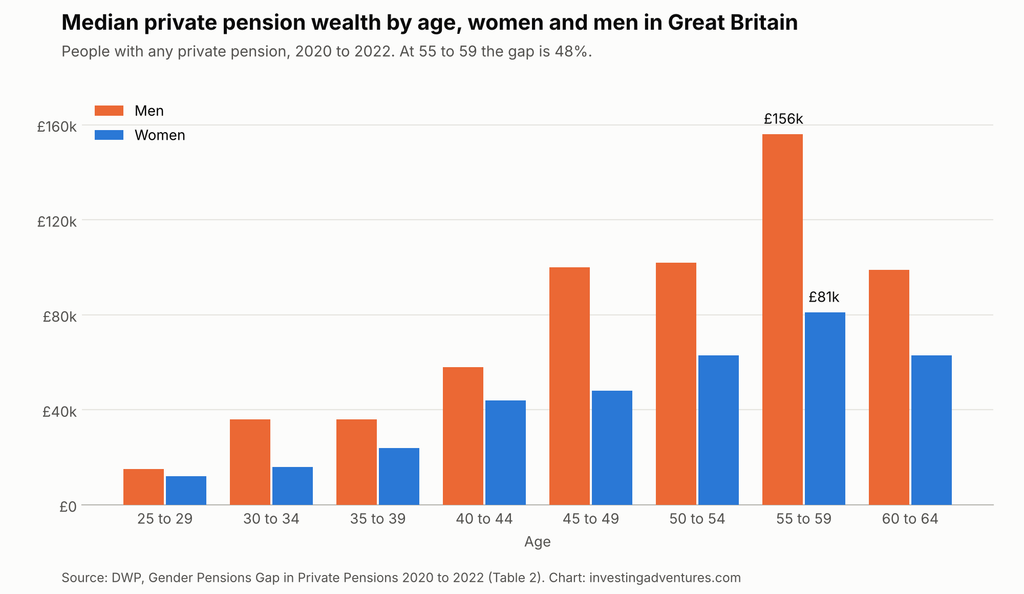
Women aged 55 to 59 have a median private pension of £81,000, against £156,000 for men: a 48% gap. That’s the government’s official measure, from the DWP’s Gender Pensions Gap in Private Pensions: 2020 to 2022, published 21 July 2025.
| Statistic | Figure | Data period | Source |
|---|---|---|---|
| Gender pensions gap, aged 55 to 59 | 48% (£81,000 women vs £156,000 men, median) | 2020 to 2022 | DWP |
| Gap including people with no private pension | 62% (£32,000 women vs £85,000 men) | 2020 to 2022 | DWP |
| Gap where people only have defined contribution pensions | 75% (£19,000 women vs £75,000 men) | 2020 to 2022 | DWP |
| Gap where people only have defined benefit pensions | 39% (£111,000 women vs £183,000 men) | 2020 to 2022 | DWP |
| Illustrative annual income from that pot at 60 | About £6,000 women vs £11,000 men | 2020 to 2022 | DWP |
| People aged 55 to 59 with any private pension | 78% of women vs 82% of men (women up from 63% in 2006 to 2008) | 2020 to 2022 | DWP |
| Women’s average private pension wealth in their late 50s, as a share of men’s | 54% | Published Sep 2026 | Pensions Policy Institute |
| Pensioners in poverty who are women | 57% | Published Sep 2026 | Pensions Policy Institute |
| Workers earning under the £10,000 auto enrolment threshold who are women | 66% | Published Sep 2026 | Pensions Policy Institute |
| Women’s average annual income as a share of men’s | 76% (£27,400 vs £35,900) | 2024 | Pensions Policy Institute |
| Age the gender pension gap starts | 28 | 2026 | AJ Bell Money Matters |
The gender pension gap by age (median private pension wealth, people with a pension, 2020 to 2022).
| Age | Women | Men | Gap |
|---|---|---|---|
| 25 to 29 | £12,000 | £15,000 | 22% |
| 30 to 34 | £16,000 | £36,000 | 56% |
| 35 to 39 | £24,000 | £36,000 | 32% |
| 40 to 44 | £44,000 | £58,000 | 24% |
| 45 to 49 | £48,000 | £100,000 | 52% |
| 50 to 54 | £63,000 | £102,000 | 38% |
| 55 to 59 | £81,000 | £156,000 | 48% |
| 60 to 64 | £63,000 | £99,000 | 36% |
Source: DWP, Table 2. The DWP notes these figures carry some uncertainty, because the survey moved from face to face to telephone interviews during Covid.
Why are there two different pension gaps? The DWP’s 48% compares median pension pots, the middle value. The Pensions Policy Institute’s 54% compares average (mean) pension wealth. Both are correct; they just measure the gap differently.
Over a career that spanned 23 years I accumulated three workplace pensions scattered across different providers. It would have been more, but auto enrolment wasn’t in place when I started working and I opted out of at least two workplace pensions that were offered to me.
At 45 I consolidated all my pensions into one SIPP. There were no fees to pay, which I was grateful for. However, when I saw the total I was hugely disappointed and overwhelmed at the amount of catching up I had to do.
Pay, career breaks and caring
The pay gap almost disappears for young women, then opens up from 40 and is widest in the 50s, which is exactly when pensions need topping up. The ONS published these figures on 22 October 2026 (provisional, April 2026 data).
| Statistic | Figure | Date | Source |
|---|---|---|---|
| Gender pay gap, full time employees | 6.8%, down from 7.2% in 2025 and 9.4% a decade ago | Apr 2026 | ONS |
| Gender pay gap, all employees | 12.3%, down from 13.0% | Apr 2026 | ONS |
| Full time median hourly pay | £20.05 women vs £21.51 men | Apr 2026 | ONS |
| Pay gap aged 30 to 39 vs 40 to 49 | 4.1% vs 8.2% | Apr 2026 | ONS |
| Pay gap aged 50 to 59 and 60 plus | 11.0% and 11.2%, the highest of any age | Apr 2026 | ONS |
| Jobs that are full time | About 60% of women’s vs 83% of men’s | Apr 2026 | ONS |
| Employed women working part time | About 35%, down from 42% in 2006 | 2025 | DWP |
| Inactive people aged 50 to 64 citing “looking after home or family” | 18.1% of women vs 7.7% of men | 2025 | DWP |
| Private sector auto enrolment savers at the minimum rate | 33% of women vs 28% of men | 2023 | DWP |
The ONS says the jump in the pay gap around 40 is largely explained by the impact of motherhood.
At 36 I stepped away from work for four years, and my pension contributions stopped completely. The three part time years that followed got them going again, but only at part time levels and smaller contributions every month. If that sounds familiar, my guide to the pension annual allowance explains how much you can pay in to catch up, even with no earnings.
Confidence, risk and attitudes
The confidence gap is real, but the “women are risk averse” story is weaker than it looks: once women invest, their risk levels look much like men’s.
| Statistic | Figure | Date | Source |
|---|---|---|---|
| Investors comfortable taking a lot of risk | 20% of women vs 44% of men | Feb 2025 | Boring Money |
| Portfolio exposure to the US stock market | 24% women vs 41% men | 2025 | eToro, via Boring Money |
| Would move to cash if interest rates fell | 30% of women vs 22% of men | 2025 | eToro, via Boring Money |
| Nutmeg clients in medium to high risk portfolios | 89% of women vs 92% of men (women up from 80% in 2020) | Dec 2024 data | Nutmeg, via DIY Investor |
| Women as a share of Nutmeg clients | 41%, up from 24% in 2013 | Mar 2025 | Nutmeg, via DIY Investor |
| Women aged 35 to 44 planning to take more investment risk | 58% vs 36% of men the same age | Jan 2025 | Nutmeg and Opinium, via DIY Investor |
| Confident making changes to investments on their own | 44% of women vs 63% of men | Spring 2026 | St James’s Place |
| Confident managing a large inheritance or windfall alone | 54% of women vs 66% of men | Spring 2026 | St James’s Place |
| Lack confidence finding suitable financial products | 21% of women vs 12% of men | May 2022 | FCA Financial Lives, via Professional Adviser |
| Average investible assets | £34,000 women vs £52,000 men | May 2022 | FCA Financial Lives, via Professional Adviser |
My attitude to risk has swung like a pendulum on a clock. I started with high risk ETFs. Then I got impatient and began buying shares in individual companies, without really knowing what I was doing. It didn’t go well: the share price dropped on four out of the five I bought. So I’ve stopped buying individual shares and gone back to ETFs.
What the Autumn Budget 2026 means for women
The 28 October 2026 Budget kept the £20,000 cash ISA limit and raised tax on savings held outside ISAs. That matters to women, who pay into the majority of cash ISAs.
| Change | Detail | Starts | Source |
|---|---|---|---|
| Cash ISA limit cut cancelled | Stays at £20,000 for all ages; the planned £12,000 limit for under 65s is scrapped | No change | Unbiased |
| Starter ISA | Government to work with industry on a new ISA for first time savers | To be confirmed | Portfolio Adviser |
| Savings tax outside ISAs | Rates rise to 24% basic, 44% higher, 49% additional | 6 Apr 2027 | thinkmoney |
| Lifetime ISA penalty | Falls from 25% to 20% for existing holders buying above the £450,000 cap | 29 Oct 2026 | thinkmoney |
| New Pension Tax Allowance | No income tax for pensioners whose total income is no more than the full new State Pension (£13,036.40 a year) | 6 Apr 2027 to 5 Apr 2030 | Unbiased |
| Pension tax free lump sum | Unchanged at 25% | No change | Freetrade |
The cash ISA U-turn protects the account most women already use. But with higher tax on savings outside ISAs from April 2027, using your ISA allowance matters more than ever, and the long term cost of keeping money in cash that you won’t need for years hasn’t changed. I’ve covered the Lifetime ISA change in more detail in the Lifetime ISA withdrawal charge reform.
What these numbers mean for you
None of these gaps are a verdict on you. They’re the sum of pay, part time years, caring and confidence, and every one of them can be narrowed a little at a time. If you’re starting late like I did, these are the guides I’d read first:
- How to start investing in the UK
- Are ISAs worth it?
- What is a SIPP?
- Should I consolidate my pensions?
- Average pension pot by age in the UK
- How much do I need to retire in the UK?
FAQ
What is the gender pension gap in the UK?
The government’s official measure is 48%. Women aged 55 to 59 have a median private pension of £81,000, against £156,000 for men, according to the DWP’s figures for 2020 to 2022. Including people with no private pension at all, the gap rises to 62%.
What is the gender investment gap?
It’s the difference between how much men and women invest. Boring Money’s January 2026 survey found 11 million men invest in the UK against 7.4 million women, a gap of 3.6 million people, and men hold £574 billion more in investments.
How many women invest in the UK?
Around 7.4 million women invest in the UK, up 10% from 6.7 million a year earlier, according to Boring Money’s January 2026 survey of 6,465 adults.
When does the gender pension gap start?
AJ Bell’s research puts the start at age 28. The DWP’s figures show the gap at 22% for people aged 25 to 29, jumping to 56% at 30 to 34, the years when many women have children.
Sources
Official statistics
- DWP: Gender Pensions Gap in Private Pensions, 2020 to 2022, published 21 July 2025
- ONS: Gender pay gap in the UK, 2026, published 22 October 2026
- DWP: Economic labour market status of individuals aged 50 and over, September 2025
- HMRC: Annual savings statistics 2026, published 16 September 2026
Research and industry analysis
- Pensions Policy Institute: The Underpensioned, Updating the Gender Pension Gap, September 2026
- Boring Money: UK Gender Wealth Gap Widens in 2026, 18 March 2026
- Boring Money via DIY Investor: Number of women investing surges 10%, 4 March 2026
- Boring Money: Gender Investment Gap increases for second year, 5 March 2025
- AJ Bell: Gender ISA gap persists, 16 September 2026
- AJ Bell: ISA use hits 13 year high, 18 September 2025
- AJ Bell: Gender tax gap narrows, 27 July 2026
- Nutmeg via DIY Investor, March 2025
- St James’s Place: Women may manage the money today
- FCA Financial Lives via Professional Adviser
Autumn Budget 2026
- Unbiased: Autumn Budget 2026 key announcements
- Portfolio Adviser: Healey U-turn on cash ISA limit
- thinkmoney: Autumn Budget 2026
- Freetrade: UK Budget Autumn 2026

Angelina is the founder of Investing Adventures, where she helps women build confidence with money and investing. With seven years of personal investing experience, she breaks down complex financial topics into practical, actionable advice. Her mission is simple: to help more women take the driver’s seat in their financial future.
I am not a financial advisor and nothing in this post constitutes financial advice. All investments carry risk and the value of your investments can go down as well as up. Please do your own research and consider seeking independent financial advice before making any investment decisions.